|
|
About the PPST
|
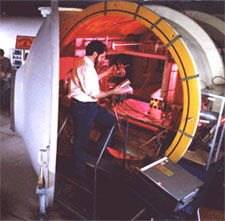
Research FacilitiesExtensive research facilities exist at the Princeton Plasma Physics Laboratory (PPPL) on the James Forrestal Campus and in the School of Engineering and Applied Sciences (SEAS) at the Engineering Quadrangle on the main campus. There are excellent libraries and outstanding computer facilities on both campuses. Princeton Plasma Physics LaboratoryMany plasma devices at PPPL are devoted to fusion research. NSTX (National Spherical Torus Experiment) was constructed by PPPL in collaboration with the Oak Ridge National Laboratory, Columbia University, and the University of Washington at Seattle. Spherically shaped plasmas could allow the development of smaller, more economical fusion reactors. The medium-sized Lithium Tokamak Experiment (LTX) has been recently upgraded for studies of advanced operational modes. Other research facilities at PPPL are:
Engineering QuadrangleThe Program in Plasma Science and Technology supports students working on research facilities in the departments of Chemistry, Chemical and Biological Engineering, Electrical Engineering, and Mechanical and Aerospace Engineering. The research is concentrated in four areas: materials processing for semiconductor fabrication, spacecraft propulsion, surface and gas phase chemistry, and development of novel lasers and their applications. Primary facilities are:
PRISMMany activities within the PPST, especially those involving plasma processing of materials and the X-ray laser, are closely associated with The Princeton Institute for the Science and Technology of Materials (PRISM), a multidisciplinary research center at Princeton University in the general field of materials science through photonics with a special emphasis on the hard material-soft material interface. Its mission includes graduate and undergraduate education and research which will have a long-term impact on society. Key elements of PRISM are the integration of the sciences and engineering, with work spanning from fundamental theory through applications, and the integration of PRISM’s work with efforts outside Princeton, especially with industry. PRISM was formed in November 2003 and is based on the foundations of two smaller interdisciplinary centers at Princeton, the former Princeton Materials Institute and the former Center for Photonics and Optoelectronic Materials. |